Tempo
Table of Contents
In Flesh and Blood, tempo, sometimes called momentum, refers to the game state where a player is in the proverbial driver’s seat; they are able to keep most or all cards in their hand (known as “full tempo”) and execute their gameplan.
You may be asking “surely you can always keep all cards in your hand if you want to? Just don’t defend?”, and that is of course true, but there always comes a point where you are forced to give up some of your cards. If your decision to not defend is effectively just bringing you closer to your eventual demise, many would consider this a situation where your opponent does in fact have tempo even though you are not technically forced to defend with your cards (yet).
Kinds of tempo
There are a few ways to sustain tempo in FaB, and they are explained below.
Disruptive tempo
Disruptive tempo is achieved when you are playing cards that disrupt your opponent, for example forcing them to discard cards with a card like Crippling Crush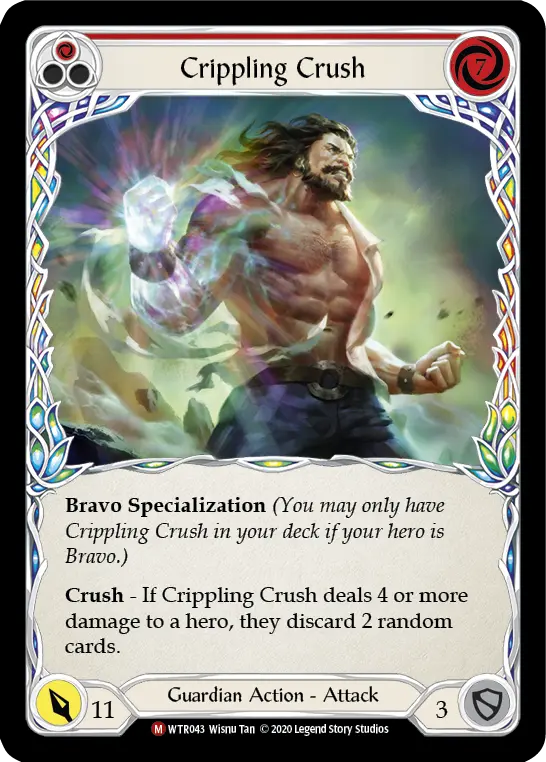 or denying them go again with a card like Spinal Crush
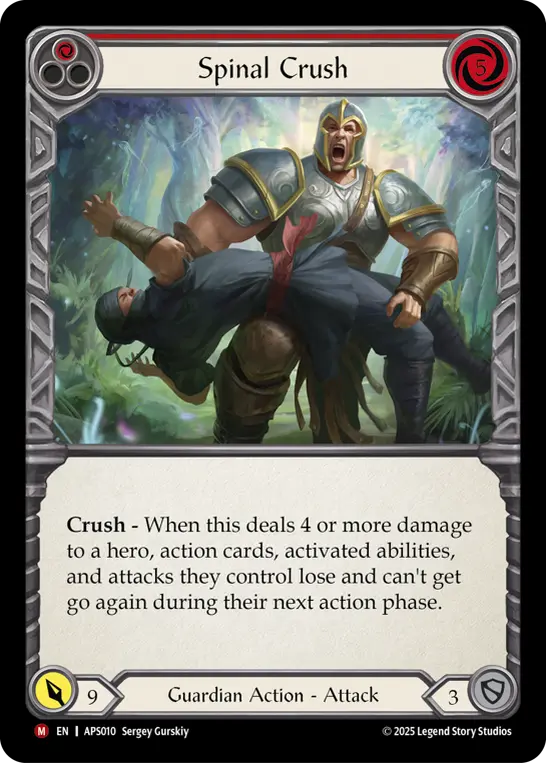 .
.
Lethal tempo
When your opponent is at low life and you are attacking for a decent amount of damage, often times they are forced to defend with most or all of their cards, and so you have tempo. When the game has reached this state, the player who has tempo could stumble if they draw a bad hand (known as “bricking”), which can turn the tide and hand tempo over to the opponent.
Board state tempo
If you play a class that is able to assemble a board state, such as Illusionist, it is sometimes possible to obtain a special kind of tempo where your allies or auras give you the ability to make powerful attacks at very low cost (sometimes for free) while at the same time preventing your opponents’ attacks from making a dent. This relies on your opponent not being able to push through and remove your board state pieces faster than you can put them out.
Guardians are particularly weak to this strategy, since we are lacking in go again attacks which are a critical tool for dealing with allies. If you send one attack for 10, all the damage and disruption is wasted on just one ally, as opposed to sending multiple go again attacks, one of which takes out the ally and the rest goes to your opponent. For ward auras, the problem is similar. Any attack threatens to blow up a ward aura, so sending many small attacks that each need to be defended to protect the ward aura is better than sending one bigger attack for 8.
How to gain tempo
Forcing tempo
It is quite easy to seize full tempo. Simply don’t defend and send a disruptive attack like Crippling Crush or Oaken Old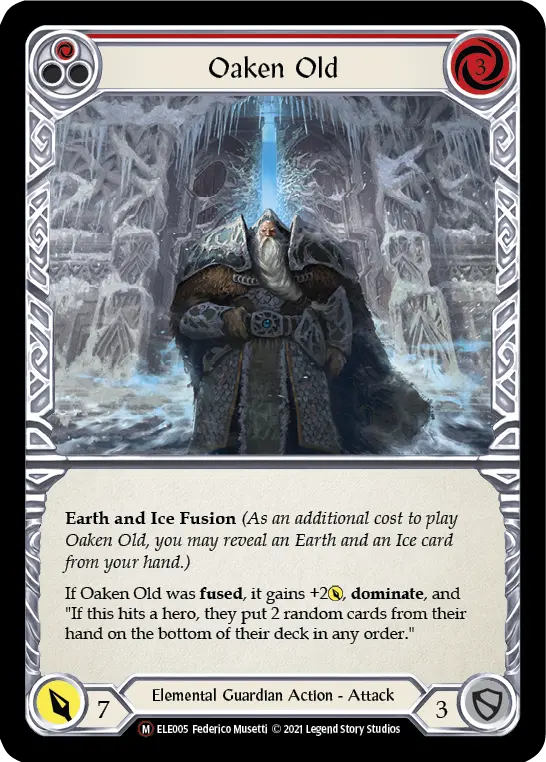 . Easy right? The problem for Guardians is that since our high costed cards require rather blue-heavy decks, we may very well draw a full blue hand on the next turn that can merely present a Chokeslam (blue)
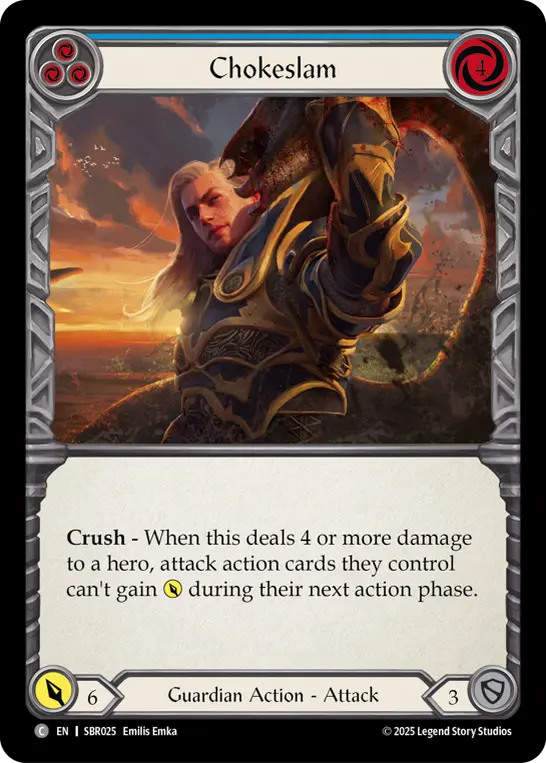 for 6. This way, we will lose the tempo just as quickly as we gained it, having taken a chunk of damage in the process.
It is for this reason that Guardians seeking to take and keep tempo have to rely on one of two main strategies to reduce the chances of the dreaded blue brick; arsenal management and pitch stacking. If you are able to save a powerful attack (or some other aggressive card like Pummel) in your arsenal when you initially seize tempo, that means you can salvage a full blue hand and keep things going. Alternatively, if you are pitch stacking, you can plan out your hands so that you know that when have reached the pitched cards, you can seize tempo and always draw hands with disruptive cards that allow you to keep the tempo.
As we can see, seizing the tempo is a decision that must not be made lightly.
Being handed tempo
Many opponents are worried about not being able to push through a Guardians’ defenses if they simply attack with their four card hand each turn. Therefore, a lot of opponents will choose to take off-turns or setup turns where they place a card in arsenal or maybe play an aura or item that can enhance their next turn(s). This is called damage compression. This means that we are given tempo basically for free. When this happens, they are hoping that we have a hand full of blue cards and defense reactions so that we are unable to capitalise on the tempo.
Unfortunately, sometimes this is correct and the best you can do is attack with a hammer. But this is something we can take advantage of in deckbuilding by including some amount of cards that are very powerful when we are handed tempo in this way, and also by choosing to arsenal cards that are very useful in situations like this, such as Command and Conquer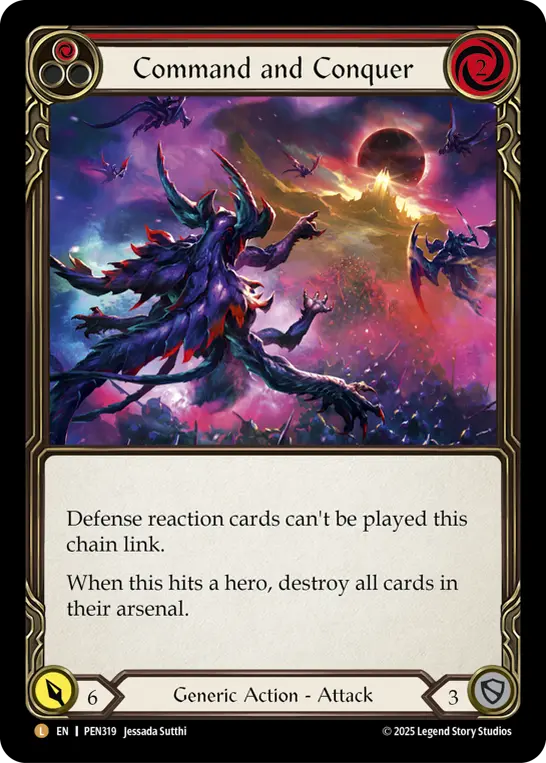 .
.
Do Guardians need tempo?
Guardians are perhaps one of the classes that are the least interested in having the tempo in the early game due to how likely it is that we will lose it to a blue heavy hand. Playing aggressively and hoping for the best is an option, especially if your deck has a good number of aggressive cards, but it’s certainly not the go-to strategy for Guardians. In some matchups this may still be your best option, for example if your opponent has some unbeatable strategy looming on the horizon, such as a game-winning combo or a powerful late game engine that is more efficient than your hammer.